



Overview
The process of developing an application has become more complex today than just choosing a platform. Besides, it also means that one has to decide on the speed of delivery, the extent of distribution, and the overall value over time. This is where cross-platform app development frameworks help out. They allow you to create one application that works perfectly on different platforms without the need for twice the time and money. If you want to go for quicker launches, steady performance, and smooth upkeep, these frameworks will help you to be on top of the game while keeping your development process smart and scalable.
Just recall the instance of Instagram or Airbnb that you couldn’t even tell which platform you were on; they all felt and worked the same way. That ease and smoothness in switching between platforms is a clear demonstration of the correct application of cross-platform mobile development. The business owner or product leader, this method not only results in getting more control but also in faster updates and improved user experience for your audience. In case you want an app that will evolve with its users, it is the right moment for you to think about the frameworks.
When one speaks about developing an application today, it is not only a matter of writing the code but also selecting the appropriate technology that will not drain your time, development budget, and effort. The cross-platform app development frameworks have thus turned into the main option for all those companies that are looking for faster results without compromising on quality. This method, if used in creating an app for both Android and iOS, not only speeds up the process but also widens the reach of the app with less input.
Try to remember your own app interaction for a short while. You want it to be fast, consistent, and not to have any issues, regardless of the device you are using. Your users are also expecting the same from you. The cross-platform approach provides you with this by letting you offer a seamless experience while controlling a single codebase. It simplifies matters, accelerates the issuing of new versions, and keeps your service in line with what the users expect.
If you want the app to grow with your business and changes along with the market conditions, then the development that you choose will affect this. The frameworks that you select today will have an impact not just on your app’s performance, user satisfaction, and growth tomorrow but also on our app’s performance, user satisfaction, and growth tomorrow.
What is a Cross-Platform App Development Framework?
Initially, cross-platform app development tools were deemed the chief technology of app development that would be compatible with different platforms, including Android, iOS, and the web. The whole process involved the developer coding an app with a cross-platform way instead of creating separate codebases for each platform; the benefits of saving time and money were enjoyed. The method still does ios android cross platform delivery, but performance is different. For example, firms that work with mobile app development frameworks such as Flutter experience a development cycle that is nearly 40% faster.
Moreover, these frameworks ride the very mobile development platform that is most potent and leads to easier design, testing, and deployment. As a consequence of this, cross-platform software development has become the preferred choice of both startups and enterprises. To mention a real case, apps like Alibaba were developed using cross-platform development tools, which have enabled them to quickly scale up to millions of users. Hence, teams achieve quicker launch times without sacrificing quality.
To sum it up, cross-platform application development is an important factor for the product to be future-proof. Maintenance costs are one of the costs that businesses using cross-platform app development in the long run have reduced, and updates have become easier to carry out.
Which Cross-Platform Frameworks are Most Popular in 2026?
The usage of cross-platform frameworks will only go up to 2026 since the major qualities that companies will seek will still be flexibility and speed. Furthermore, a Statista survey reveals that currently, the majority of developers using mobile development tools (more than 55%) are inclined to choose cross-platform frameworks rather than the native-only method.
Stages of Building a Cryptocurrency Exchange Platform Architecture
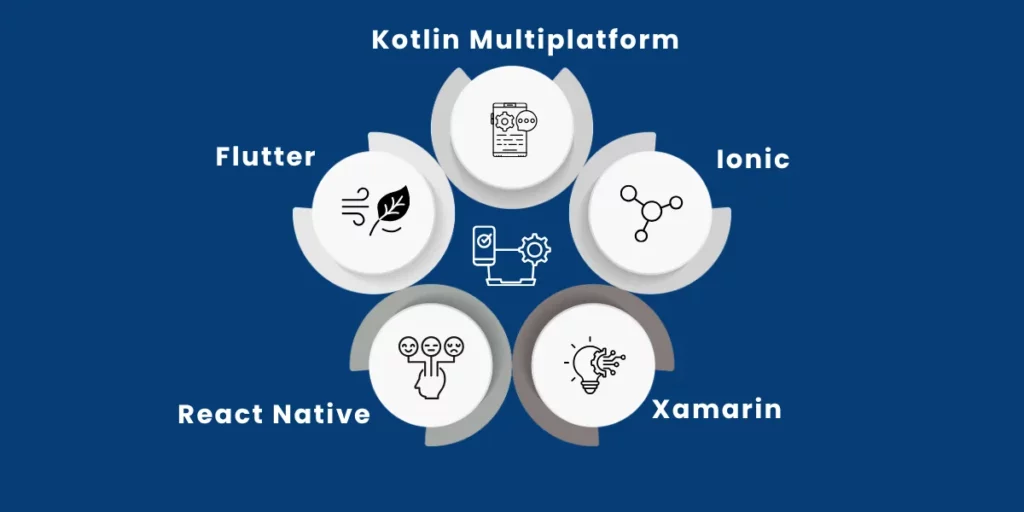
1. Flutter
Flutter tops the list with its promise of good UI performance across platforms. Google claims that Flutter’s contribution to the shortening of development time by almost 30% is significant. An excellent instance of this is Google Ads, which employs Flutter for a design that is coherent throughout the different platforms.
2. React Native
React Native is a solution for mobile app development cross- platform by means of reusable components. The apps of Facebook and Instagram are both relying on this technology for the rapid rollout of frequent updates. It results in a huge reduction of development costs when compared to native apps.
3. Xamarin
With the help of C#, Xamarin allows developers to create multiplatform mobile app development. The backing by Microsoft adds to its reliability for enterprise apps. Alaska Airlines, for example, has opted for Xamarin to ensure that the performance is consistently high throughout.
4. Ionic
Ionic prides itself on cross-platform web development with mobile capabilities combined. It is an ideal solution for startups that require building MVPs very fast. Ionic is particularly useful for hybrid apps since it makes UI development easy.
5. Kotlin Multiplatform
This alternative allows you to share the same logic across platforms and thus supports multiplatform app development. Over time, it is slowly being adopted by Android-first teams.
Why are Businesses Shifting to Cross-Platform Development?
To begin with, businesses are taking the road of cross-platform mobile app development due to the factor of cost efficiency. According to Deloitte, developing a single application instead of two saves about 35% costs. This leads to the situation where startups can spend their budgets on growth rather than creating new applications.
In addition, mobile cross-platform development allows entry to the market more swiftly. For example, Airbnb adopted cross-platform software to keep device updates consistent. Through this, users get the features at the same time, which adds to their contentment.
Ultimately, the cooperation with a trustworthy cross-platform app development company guarantees scalability. Furthermore, firms associated with a cross-platform mobile app development company indicate better maintenance cycles.
Choose the Right Cross-Platform Framework for Your App
The selection of the correct solution begins with a clear understanding of your objectives. In case speed is a priority, then the best cross-platform mobile development tools, such as Flutter, will be the right option. If not, then enterprise applications will get better with Microsoft-supported cross-platform app development services. Actually, the choice of the product development platform still affects long-term success directly.
Moreover, consorting with skilled cross-platform app development firms results in superior architecture and security. An established cross-platform mobile development company could lead you to the best cross-platform app development techniques while still being in line with the business objectives.
The Future of Cross-Platform App Development
The cross-platform mobile application development future is bright, as the need for multi-platform app development increases. According to Gartner, by 2027, 70% of apps will be using multi-platform techniques.
- AI-Powered Tools: Cross-platform development tools will integrate AI for testing and UI design, enabling faster and more accurate results.
- Stronger Enterprise Adoption: Enterprises will increasingly adopt cross-platform solutions for improved security, scalability, and efficiency.
- Unified Ecosystems: Seamless integration between web and mobile platforms will help businesses build connected digital ecosystems.
- Advanced Tooling: Enhanced development tools will offer better performance monitoring, which is essential for large-scale applications.
- Greater Accessibility: Cross-platform solutions will enable users to access apps across multiple devices, increasing overall adoption.
- Developer-First Focus: Frameworks will prioritize developer experience, making app development more efficient and streamlined.
Ready For Digital Transformation?
Grow your business with advanced technology and expert digital solutions.
You have a vision. We can help you achieve it.
Bring your vision to life with our expert team. As a global leader, we pave the way in the new era, bringing your ideas to fruition. Partner with us to make your vision a success.
Conclusion
To sum it up, picking the appropriate cross-platform app development frameworks has transformed into a tactical decision affecting all stages of your app’s life, time to market, performance, and expansion. Using the right framework brings about less complexity, higher user satisfaction and more readiness for future growth and market changes. What matters, however, is to develop an app that serves the needs of the users as well as a slow but sure, future-proof development process.
With a demonstrated record of delivering scalable, secure, and business-oriented solutions, our team will assist in picking the right strategy according to your objectives, the period of time you have, and the users. It is the right time to make the transition from planning to executing. Get in touch with Revinfotech and take the initial move towards creating an app that not only stands out but also grows with ease and brings a significant impact on the business.
Frequently Asked Questions
How long does it take to build a cross-platform mobile app?
+
The timeline depends on app complexity and features, but cross-platform apps are usually built faster than native apps. Many projects see up to 30–40% faster development cycles, helping businesses launch quickly and adapt to market demands.
Is cross-platform development more cost-effective than native development?
+
Absolutely. Cross-platform development reduces costs by maintaining a single codebase instead of multiple ones. This approach lowers development time, testing effort, and long-term maintenance expenses, making it ideal for startups and growing businesses.
How does cross-platform development affect app performance?
+
In most cases, performance is comparable to native apps when best practices are followed. Advanced frameworks now offer near-native speed and responsiveness. This is why businesses using cross-platform development continue to deliver seamless user experiences.
Are cross-platform apps suitable for complex and large-scale applications?
+
Yes, modern cross-platform frameworks are capable of handling complex and large-scale applications. With the right architecture and experienced development team, you can achieve high performance, strong security, and smooth scalability. Many enterprise apps today successfully run on cross-platform solutions.

Article written by
Navdeep Garg, CEO of Revinfotech
<p>I am the founder and CEO of Revinfotech Inc., with over 15 years of experience in leadership, financial services, FinTech, technology, and business management. I am a strategic business leader and hands-on practitioner with a strong track record of buildin ...Read More
Inspired by These Insights? Let’s Talk.
From understanding trends to building solutions, we're here to help you take the next step. Our experts are ready to guide your digital transformation.


