


The in-house development versus outsourced product development debate is a critical business-based decision for a company that is innovative or is looking to expand. The correct choice can potentially affect your product development process, efficiency, and, subsequently, your success. This blog will weigh the advantages and challenges of the approaches to help you choose the best one.
It allows companies to fully retain control of the new product development strategy in-house. This might unify a team and provide an excellent cultural fit and alignment with the company’s goals. However, it does require rather significant investments in resources and talents, which might be challenging for a small business to make.
However, access to specialized knowledge and advanced technologies that might not be available internally can be obtained by outsourcing product development services. This approach can accelerate the new product development process and reduce costs. Yet, it also comes with risks such as potential communication barriers and less control over the final product.
What Benefits and Drawbacks Can In-House Development Offer?
In-house development has many benefits, especially for businesses that insist on control and customization. Keeping the new product development process in-house will guarantee that the team is fully aware of your vision and the objectives of the company. In-house development is usually more coherent, where the team is likely to understand much better the culture and long-term objectives of the business.
In-house development also has its issues. The massive investment of time, money, and resources stands among the most significant drawbacks. The cost of hiring and training a skilled development team is extremely high, and such a team can continue to put pressure on the budget of any company, especially smaller ones. Besides, the in-house team may lack specific experience or the latest technologies available for specialized product development services.
Another factor that has to be considered is the scalability and flexibility of the in-house development process. When market demands and technology trends change, it could be tough for the in-house team to keep pace unless a company continues investing in training and resources.
Furthermore, this might disallow the company to adapt the new product development strategy to the weathering conditions of the market. However, product development services, which are primarily offered by other companies, are considerably more adaptable and readily available with a wealth of knowledge, which could enable a company to accelerate development and maintain its competitiveness in a market that is changing quickly.
What Dangers Come with Contracting Out the Creation of New Products?
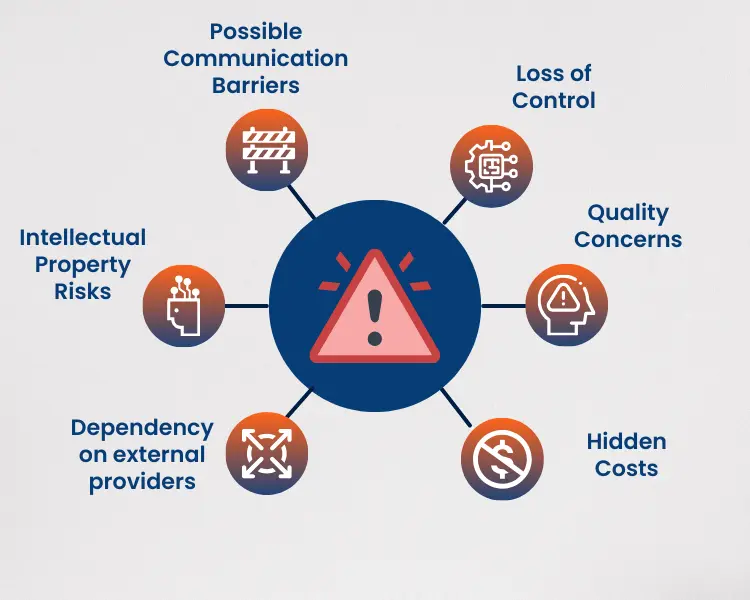
1. Possible Communication Barriers
Probably the most critical risk of outsourcing new product development is communication barriers. Sometimes, when working with an external team, because of differences in time zones, languages, or working cultures, there can be misunderstandings and delays. These issues may add complexity to the process of new product development and result in misaligned expectations or requirements.
2. Loss of Control
While outsourcing, businesses may lose control over the new product development strategy. Unlike in-house development, where the team is close to the vision and goals of your company, external providers may not understand the finesse of your business needs. It is this gap that can hit hard on the quality of the final product and adherence to standards set by your company.
3. Quality Concerns
This may sometimes lead to quality concerns with outsourced product development services. You cannot expect the same level of interest or commitment to your product from an external team as you had it in-house. It might therefore be inconsistent or detailed, below expectations, and hence affect the market reputation.
4. Intellectual Property Risks
This could lead to the risk of IP issues during the outsourced development of new products. Outsourcing essentially involves providing access to sensitive information and may pose the risk of information leakage or theft. Ensure proper legal protections and confidentiality agreements are in place to avoid this risk and protect your company’s innovations.
5. Dependency on external providers
This can lead to dependency on external product development services, which may be detrimental in the long run. Your project may get delayed if the outsourced team experiences problems or the delivery is not completed correctly. This dependence may also make it more difficult for you to quickly make adjustments or refocus your new approach to product development.
6. Hidden Costs
Even though outsourcing could appear to be a cost-effective option, there are some additional expenses. These can range from costs for managing the outsourced relationship to unexpected revisions or extra features not accounted for earlier. The existence of these hidden costs brings down the financial advantage accruable from outsourcing as compared to in-house development, where expenses are normally more predictable and controllable.
Which Methodology is Best for Your New Product Development Plan?
The choice between in-house development and outsourcing depends on several factors that are unique to your business. It can simply be characterized by unique advantages and drawbacks in both approaches; therefore, it is vital to consider the company’s needs, resources and aims.
Control and customization: In-house development guarantees more control and customization to ensure that the development relates to the vision and goals of your company.
- Availability of Resources: In the case of outsourcing, specialized skills and technologies not found within the organization are made available, which expedites the development process.
- Cost: In-house development involves investing substantially in recruitment and training. On the other hand, outsourcing has concealed costs in the administration of external relationships.
- Quality Assurance: An in-house team could be more focused on and familiar with your product. However, outsourcing can sometimes lead to quality problems if not managed properly.
- Flexibility and Scalability: Outsourcing will be much more flexible in scaling development efforts quickly, while in-house teams don’t adapt to changing demands without huge investments.
- Intellectual Property Security: Better control of the latter can be assured through in-house development, while outsourcing involves stringent legal protections to assure the safety of sensitive information.
Ready For Digital Transformation?
Grow your business with advanced technology and expert digital solutions.
Conclusion
It’s all about your business needs, resources, and goals when choosing the right way to go in-house developing your new product: in-house development vs. outsourcing. A crucial choice for companies looking to innovate and expand is whether to outsource or internally create new products. With its full range of outsourced product development services, Revinfotech provides professional solutions that are customized to meet your unique requirements.
Both approaches have definite benefits and challenges in the spheres of control and customization, flexibility, and scalability. Weigh carefully such parameters as the availability of resources, cost, assurance of quality, and security of intellectual property, and you will pick a method that aligns with your vision and objectives for the company, hence assuring you of a successful and efficient product development process.
Frequently Asked Questions
What is outsourced product development?
+How does outsourcing product development reduce costs?
+What are the main benefits of outsourcing product engineering?
+Why is outsourced product development important in 2024?
+
Navdeep Garg, CEO of Revinfotech
I'm founder and CEO of Revinfotech Inc. I traits in leadership and brilliant practitioner in the Financial Services and FinTech. I helped ban in connecting to the FinTech ecosystem through payment acceptance in blockchain as a service and even help i... read more