Overview
Mobile payment apps have gradually but surely integrated themselves into your daily habits. They have turned the once-difficult process of transferring money into seconds through their use. The apps, while functioning in the background, are effectively and securely establishing a connection between your bank, card, or wallet and a digital platform that, among other actions, verifies your identity, encrypts your data, and carries out the transaction instantly. What you perceive as simply a tap or a scan is, in fact, a quick and secure procedure that is built around protecting your money and your trust, which is why every payment appears to be easy and trustworthy.
A payment app acts as a digital bridge between you and the seller. Take, for instance, when you scan a QR code at a retail shop, the app assesses your balance, verifies the receiver and settles the transaction without using cash or cards. You remain in charge, receive instantaneous confirmations, and have each transaction consolidated in one spot for tracking. If you want to experience quicker checkouts and better management of your funds, this is the perfect moment to begin using a payment app that aligns with your way of life and guarantees every transaction to be both efficient and safe.
The
mobile payment apps have revolutionised money management in your day-to-day life. Substantially, if you are paying for groceries, booking a ride, or sending money to a friend, these are all done with just a few taps. Cash is no longer part of your daily life, and changing coins is no longer a concern. What is important now is the speed, convenience, and security, and that is the exact thing these apps are intended for. So if you are a person valuing time and simple solutions, then this transition is already favouring you.
Consider how often you get your phone out before your wallet. This simple act shows that you are starting to trust technology with your finances even more. The usage of cards is such that it has been incorporated in your day-to-day activities, thus making the transactions feel natural and non-stressful. You receive immediate confirmations, get clear records, and have better control of your spending. Most importantly, you have access to your money anytime and anywhere.
The shift towards cashless transactions is an ongoing process for both enterprises and consumers, and it is thus imperative for any person to know the workings of these systems thoroughly. A deeper understanding would guarantee that the decisions made would be more accurate. If you are after speedy payments, enhanced security, and an effortless financial experience, then this is the perfect time to look into the alternatives that will not only satisfy your needs but also keep you at the top of the digital-first world.
How do Online Payment Apps Manage Transactions in a Secure Manner?
To begin, secure transactions are set in motion no sooner than when you launch the payment app and transfer the money. Your information is encrypted before it is sent out of your device, which signifies that the sensitive data is converted into a code that is impossible to decode. This also means that even if someone manages to intercept the data, it will be of no use to them.In reality, an industry report of 2024 indicated that more than 90% of digital payment fraud tries fail because of the use of advanced encryption and authentication layers.
Moreover, mobile payment processing is based on multi-step verification.The security consists of authentication of devices, usage of PINs, biometric recognition, and real-time monitoring of transactions. This means that any unauthorized activity will be detected immediately. For instance, a transaction that is not in line with your typical behavior may lead to the payment being put on hold till you confirm the transaction. Therefore, security operates silently in the background taking care of you and letting you have a hassle-free payment experience.
However, the most significant thing mobile payment security is steadily being enhanced. Providers are spending a lot on AI-based fraud detection, as the number of transactions is increasing. As a result, users enjoy risk-free payments over time. What really matters to a user is trust, and modern systems are designed to guard it at every stage.
How do Mobile Payment Apps Transfer Money From One User to Another Within Seconds?
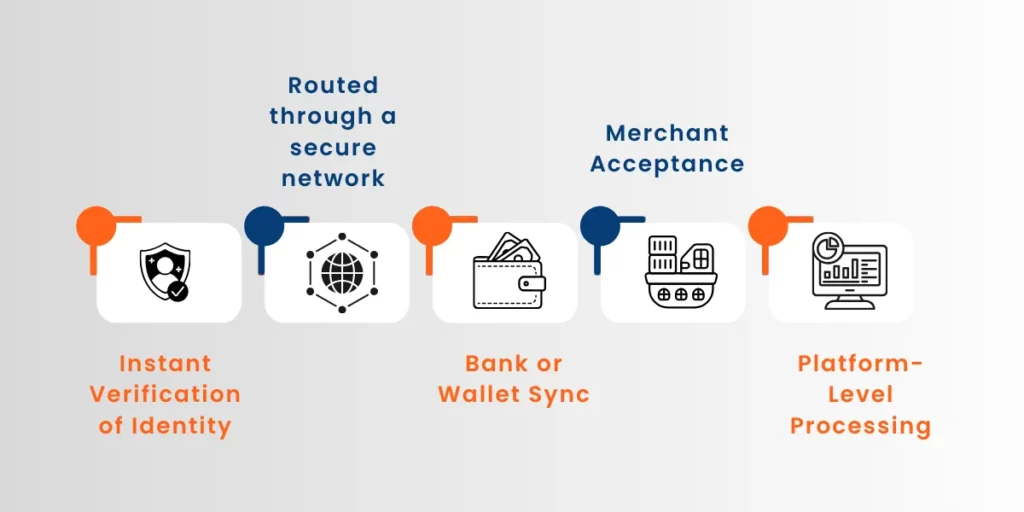
The main reason why a mobile payment app is able to transfer money quickly is the collaboration of different systems working simultaneously. Here’s a detailed explanation of the procedure behind the scenes.
1. Instant Verification of Identity
In the beginning, PINs and biometrics are used to verify your identity. This measure guarantees that only the user can approve the transaction.
2. Routed through a secure network
In addition to that, encrypted channels are used for routing your request by mobile payment systems. This is the way that data moves securely and rapidly.
3. Bank or Wallet Sync
Moreover, your bank or wallet that is linked to the mobile payment system checks if you have money in your account. This is done without any manual approval.
4. Merchant Acceptance
For physical purchases, the mobile payment terminal gets the approval at once. For instance, using a QR code takes just a few seconds to finish the transaction.
5. Platform-Level Processing
On the other hand, mobile payment platforms manage settlement and alerts. An excellent instance of this is phonepe where the confirmations are nearly real-time.
Are Mobile Payment Apps Secure Enough To Be Used For Daily Financial Transactions?
Everyday online payment apps raise an issue that is primarily about safety. According to RBI data, the percentage of digital payment fraud is only 0.002% of the total transaction value which is quite a strong proof of the system’s trustworthiness. In contrast, losing cash or having a card stolen is much more risky.
Layered security is, however, offered as a standard in modern mobile payment methods. This involves Device binding, real-time alerts, and spending limits up to a point where even if you lose your phone, unauthorized access is very unlikely. You, in fact, still control your money.
Conversely, the habits of the users affect the safety as well. The security of not-so-complex mobile payment transactions can be maintained by the use of complicated PINs and by avoiding the use of public Wi-Fi. Ultimately, the choice of technology still remains the main barrier, however, its ideal usage can make it even more powerful.
How are Businesses and Consumers Opting for Mobile Payment Systems?
Mobile payments have slowly but surely taken over as the most favorite way of payment. Mobile transactions worldwide, based on data from Statista, went beyond $9 trillion in 2023. This increase in volume has resulted in faster checkouts and reduced payment failures in the case of businesses. For customers, the biggest benefit remains convenience.
Also, brands like Boost Mobile Payment are eliminating the hassle of making recurring and on-the-go transactions. For example, paying for monthly services without having to go to a store is a huge time and effort saver. This transition results in better customer satisfaction.
Moreover, the option of Boost Mobile payment by debit cards is one of the features that allow users to have credit-free flexibility. As a result, they intuitively feel more in control of their finances. However, the key factor is the speed and the mobile payments are very fast.
The Key Advantages of Using Online Payment Gateways for Daily Transactions
Mobile payment has been groundbreaking when it comes to handing over money for everyday life. In other words, the users of these services have the same control over their finances as before but accompanied by a more transparent and less cumbersome process. The following are the main reasons for the preference of users for advanced mobile payment options:
- Speed and Convenience: Mobile payments are processed almost instantly, eliminating queues and reducing manual effort.
- Better Expense Tracking: Every transaction is recorded, making it easier to manage and monitor personal finances.
- Enhanced Security: Features like biometric authentication and instant notifications provide stronger protection compared to cash.
- Greater Acceptance: Mobile payments are widely accepted across stores, apps, and services, ensuring a seamless payment experience.
- User-Friendly Experience: Payment apps are designed with simple interfaces, making them easy for anyone to use.
- Anytime Accessibility: Users can make payments from anywhere, integrating digital transactions into everyday life.
Conclusion
Mobile payment apps have completely changed the process of making everyday transactions for you by making payment methods quicker, more secure, and more convenient. With a combination of swift QR scans and immediate confirmations, payments have become a part of your daily life without any inconvenience and at the same time you are in better control of your finances. The most remarkable aspect of mobile wallets is their ability to minimize friction at checkout, enhance security, and even promote better budgeting.
For Revinfotech, these technological innovations are not just trends; they are the ability to develop payment systems that are more advanced and more adaptable to the needs of businesses. In case you are contemplating a launching, an improvement, or the buying of a digital payment system, this moment would be perfect for it. Get in touch with the specialists at Revinfotech and discover the custom solutions that will meet your targets.