


Cloud-native application development has been a game-changer across the digitized world today. It can help companies make resilient, scalable, and strong applications that draw on all the strengths of cloud environments. As more enterprises recognize the benefits of building cloud-native applications, demand for cloud-native application development services will grow.
Some other important benefits of cloud-native application development are that it smooths the development process and empowers businesses to be agile against changes in the market and needs expressed by customers. It is the professional expertise of cloud-native application developers that enables companies to create agile, adaptive applications. Leading platforms like Oracle Cloud Native Application Development provide full tools and services that assist in this modern approach.
As businesses increasingly turn to cloud-native strategies, they gain flexible, cost-effective, and secure environments for development. Be it a startup or a well-established corporation, cloud-native application development can stimulate innovation and growth for long-term success.
Why Should Companies take into Account the Development of Cloud-Native Apps?
One must take seriously the fact that cloud-native application development offers unrivalled flexibility and scalability, which helps one to respond in good timing to changing market demands. Traditional applications scale less efficiently, thus resulting in performance bottlenecks and increased costs while user demand increases. Contrary to this, cloud-native applications are written to allow one to fully exploit the capabilities of the cloud infrastructure so that it can enable automatic scaling and resource optimization.
The next compelling reason that will review the need to adopt cloud-native app development is the speed and agility that this brings to the development process. Cloud-native applications are created by microservices architecture, so it allows developers to create, deploy, and update components independently. It has meant that businesses can iterate very quickly on their applications, incorporating new features and improvements in a way that was unimaginable only a short time ago, thereby keeping themselves competitive in a moving market.
This in turn gives a boost to the security and resilience of the application as a whole. Advanced security options, like threat detection, automated analysis, and real-time monitoring across applications, can be exposed to businesses through cloud-native tools and services. Cloud-native architectures are fault-tolerant and designed top-down for redundancy and self-healing to ensure high availability even in the presence of failures.
What are the Main Advantages of Services for Developing Cloud-Native Applications?
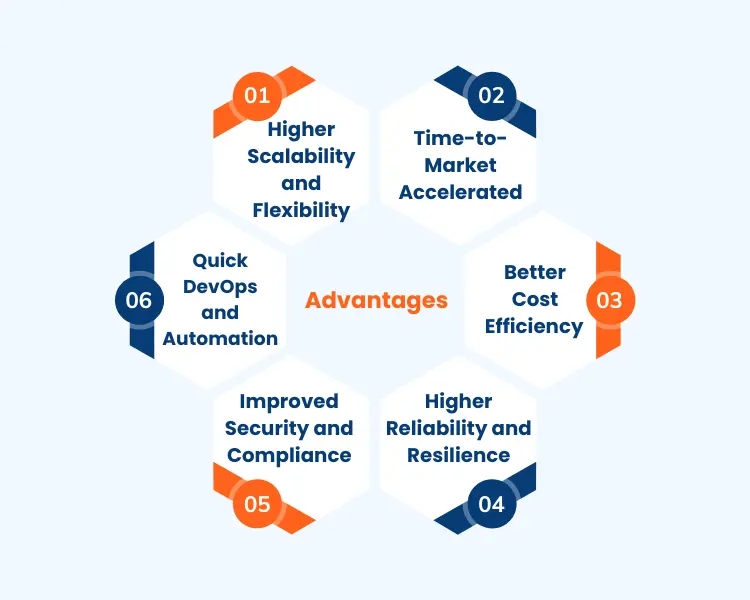
1. Higher Scalability and Flexibility
Cloud-native application development services provide an easier way for businesses to scale their applications in light of surging demands. This, in turn, makes sure that performance remains optimal during traffic spikes without an escalation in associated costs.
2. Time-to-Market Accelerated
With cloud-native development, a business can rapidly create, test, and deploy applications. In other words, such a pace makes it easier to quickly enter the market and for the company to stay competitive and agile in responding to changing market trends.
3. Better Cost Efficiency
Cloud-native services are resource-use-optimized, reducing the need for huge on-premise infrastructure. This, in turn, benefits businesses through reduced operational costs and pay-per-use-based pricing models that scale expenses as per usage.
4. Higher Reliability and Resilience
Cloud-native applications are designed to be fault-tolerant and resilient. Hence, they are highly available and virtually reduce downtown periods, ensuring continuity of service and a smooth user experience.
5. Improved Security and Compliance
Advanced security features, including automated threat detection and encryption, are built into cloud-native development services to keep organizations compliant with industry standards while protecting sensitive data.
6. Quick DevOps and Automation
Cloud-native environments are supported for the integration of DevOps practices that allow for continuous integration and delivery. Automation tools further improve this efficiency, allowing for smoother and more consistent development cycles.
How Can the Development of Cloud-Native Applications Improve Scalability?
Cloud-native applications are much more flexible than the others due to their flexibility and the distributed architecture native to the cloud. These applications will scale out by design. They efficiently add or remove resources whenever there is a change in demand. This helps to maintain optimal performance in cases of peak usage without incurring extra costs.
- Horizontal Scaling: Add or remove resources to meet demand. Provide consistent performance without over-provisioning.
- Microservices Architecture: Because all services are independent, it is easier to scale the component in isolation, which requires more resources.
- Containerization: Containers package applications into a lightweight, portable format. Therefore, it’s easier to replicate and scale across a variety of environments.
- Load Balancing: It distributes traffic automatically across multiple servers, so no single point ever becomes a bottleneck.
- Elastic Infrastructure: This infrastructure enables resources to scale up or down in real time to meet the dynamic, changing needs of an application.
How does Oracle Contribute to the Development of Cloud-Native Applications?
Oracle is undoubtedly one of the biggest players in the cloud-native application development space, in which developers have been provided with a powerful set of tools and services that have specifically been purpose-built to support modern applications. Businesses can leverage Oracle Cloud Native Application Development to efficiently build, deploy, and manage cloud-native applications powered by advanced infrastructure from Oracle.
Most of these services have something to do with the application’s complete life cycle, from development to deployment. As a result, companies can create scalable, resilient applications optimized for the new cloud environment. One of Oracle’s contributions to cloud-native application development is its support for microservices, containers, and Kubernetes.
These are mainstay technologies in the construction of cloud-native applications since they let developers build modular, scalable elements that can be managed and updated independently. Oracle cloud-native application development services provide integrated services for container orchestration, continuous integration, and continuous delivery, thus allowing their developers to speed up development cycles and bring more operational efficiency into cloud-native applications.
Ready For Digital Transformation?
Grow your business with advanced technology and expert digital solutions.
Conclusion
In summary, cloud-native application development is a game-changing paradigm for any business aiming to be competitive today. Enterprises building strong and agile applications on top of scalable, secure, and flexible cloud-native services are quite well-positioned for today’s market demands. With the help of industry leaders like Oracle, businesses can now confidently move into the intricacies of cloud-native environments to drive innovation and long-term success. Cloud-native strategies not only boost operational efficiency but also set up firms for success in an evolving technical world.
Moreover, a cloud-native app is being incorporated into the Development of businesses at a leading pace by Revinfotech. Our expertise enables Development for businesses to increase data integrity, minimize administrative workloads, and expedite compliance procedures. By implementing the Cloud-Native App, Development practitioners in businesses may effectively comply with regulations while upholding the highest requirements for treatment for patients and data security.
Frequently Asked Questions
What is cloud-native app development?
+How will cloud-native application platforms evolve in the future?
+What role does low-code development play in cloud-native applications?
+Why is Kubernetes important for cloud-native app development?
+
Navdeep Garg, CEO of Revinfotech
I'm founder and CEO of Revinfotech Inc. I traits in leadership and brilliant practitioner in the Financial Services and FinTech. I helped ban in connecting to the FinTech ecosystem through payment acceptance in blockchain as a service and even help i... read more