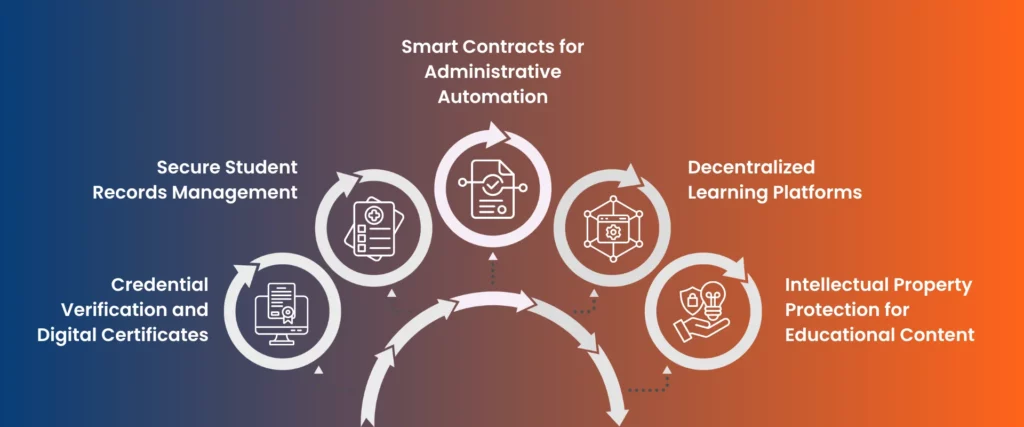
One of the most practical blockchain education use cases is the issuance and verification of digital certificates. When a university issues a degree on the blockchain, that record exists permanently. Employers, other institutions, or licensing bodies can verify it in seconds without needing to contact the issuing university.
MIT’s Digital Diplomas project, built in partnership with Learning Machine, was one of the earliest real-world implementations. Since then, the movement has grown rapidly. In September 2025, Dr. APJ Abdul Kalam Technical University in India issued approximately 50,000 blockchain-verified degrees during a single convocation ceremony. These digital certificates blockchain records give graduates full ownership of their credentials, allowing them to share verified proof with anyone, anywhere.
2. Secure Student Records Management
Educational institutions handle enormous volumes of sensitive data, from enrollment records and financial aid information to disciplinary histories and health records. A single data breach can compromise thousands of students.
Blockchain academic records are stored across a distributed network rather than in a single centralized database. This means there is no single point of failure. Data is encrypted and only accessible to authorized parties, giving students more control over who sees their information. For institutions, it reduces the administrative burden of managing, storing, and securing paper-based records. The result is stronger blockchain student data security at a lower operational cost.
3. Smart Contracts for Administrative Automation
Smart contracts in education are self-executing programs stored on the blockchain that automatically trigger actions when predefined conditions are met. In practice, this means a smart contract can automatically issue a certificate when a student completes all required coursework, process tuition fee payments on schedule, or release scholarship funds when a recipient meets academic benchmarks.
The University of Nicosia in Cyprus was an early adopter of this approach, using blockchain-powered smart contracts to automate tuition payments. By removing manual intervention from routine administrative tasks, institutions save time, reduce errors, and cut operational costs.
4. Decentralized Learning Platforms
The rise of online education has created a new challenge: how do you verify that the person who completed a course actually learned the material? And how do you ensure content creators are fairly compensated? A decentralized learning platform built on blockchain can address both.
These blockchain based learning platforms connect educators and students directly, removing intermediaries that inflate costs without adding clear value. Educators can publish course material, set pricing, and receive payments through smart contracts. Students earn verified micro-credentials that are portable and instantly verifiable. This model encourages peer-to-peer learning and allows niche educators to reach global audiences without relying on a centralized platform that takes a large revenue share.
5. Intellectual Property Protection for Educational Content
Content piracy is a genuine problem in education. Researchers, course creators, and authors invest significant time producing original work, only to see it copied and redistributed without credit or compensation. Blockchain provides a transparent way to timestamp and register intellectual property at the point of creation.
Once educational content is registered on a blockchain, the ownership record is permanent and publicly verifiable. This protects the creator’s rights and creates a clear chain of provenance that can be used to resolve disputes or enforce licensing agreements. For institutions producing proprietary research, this adds a layer of protection that traditional copyright filing alone cannot match.
Benefits of Blockchain Technology in Education
The benefits of adopting blockchain for the education sector are practical rather than theoretical. Institutions that have implemented
blockchain solutions report measurable improvements in several areas.
Transparency and trust increase because every transaction is visible and auditable by authorized parties. Data security improves because records are encrypted and distributed, with no single point of failure. Administrative costs decrease as smart contracts automate repetitive tasks like credential issuance, enrollment verification, and fee processing. Global interoperability becomes possible because blockchain-based credentials can be verified across borders without institution-to-institution coordination. Student ownership of data improves because learners control their own records and can share them with employers or other institutions directly.
These are not speculative advantages. They are already being realized by institutions deploying edtech blockchain solutions in credential management, records administration, and learning delivery.
Challenges of Implementing Blockchain in Education
Adopting blockchain technology in education is not without obstacles. The implementation costs are significant, particularly for smaller institutions. Building or integrating a blockchain platform requires investment in infrastructure, software development, and skilled personnel.
There is also a steep learning curve. Administrators, faculty, and IT teams need to understand how blockchain works and how to manage it. Without proper training, adoption stalls or fails entirely. Scalability remains a concern, as blockchain networks can slow down under heavy transaction loads. Regulatory uncertainty adds another layer of complexity, since education data privacy laws vary significantly by country and are still catching up to the technology. Finally, the lack of universal standards means that blockchain implementations at one institution may not be interoperable with another, reducing the network effect that makes blockchain most valuable.
The Future of Blockchain in Education
The future of blockchain in education is closely tied to the broader adoption of digital credentials and the growth of lifelong learning. As more professionals pursue continuous upskilling through micro-credentials, short courses, and professional certifications, the demand for a unified, portable, and verifiable record of achievement will only grow.
Governments in over 30 countries are already exploring or implementing blockchain-based verification mandates. The integration of blockchain with complementary technologies like AI, IoT, and self-sovereign identity (SSI) frameworks will further expand what is possible. Imagine a student whose learning path is continuously recorded on the blockchain, from a high school diploma through university, professional certifications, and employer-issued skill badges, all in one verifiable, learner-controlled profile.
That is not science fiction. It is the direction the industry is moving, and institutions that invest in blockchain infrastructure now will be positioned to lead when this becomes standard.
Final Thoughts
Blockchain in education is not a trend. It is a practical solution to real problems that have plagued the education sector for decades: credential fraud, data insecurity, administrative inefficiency, and lack of cross-border interoperability.
The technology is maturing, costs are falling, and early adopters are already seeing measurable results. Whether you are a university administrator evaluating new systems, an edtech founder building the next platform, or a policy maker considering digital credential standards, blockchain deserves serious attention.
At
RevInfotech, we build blockchain solutions for real-world applications, including education. If your institution is ready to move beyond paper-based records and manual verification, we can help you get there.