In today’s app-driven world, application development companies are the driving force behind every seamless digital experience. These teams of developers and designers create the tools, platforms, and products that simplify everyday life and help businesses stay connected with their customers. Whether it’s the app you check each morning or the system that keeps a company’s internal operations running efficiently, these companies are at the heart of modern digital transformation services.
Think about it: every tap, swipe, or click you make on your phone or computer ties back to professionals who shaped that interaction. They don’t just write code. They solve real problems, streamline usability, and build digital pathways that feel effortless. While the work is deeply technical, it ultimately comes down to understanding people — what they need, what frustrates them, and what keeps them engaged.
With technology evolving at an unprecedented pace, the demand for smarter, faster, and more intuitive applications continues to grow. Choosing the right partner among app development services providers is no longer just a technical decision — it’s a strategic one. This blog walks you through how modern application development is reshaping the digital landscape, what sets a great development company apart, and how brands can lead through innovation.
How do Application Development Companies Ensure Scalability?
Scalability is the defining factor behind every successful modern digital product. Leading application development companies achieve this by building systems on flexible, scalable app architecture that accommodates growing user bases, expanding feature sets, and shifting market demands.
Development teams rely on cloud-based application development services that enable dynamic resource scaling, ensuring consistent speed and uptime even during peak traffic. By using microservices, containerization, and well-structured API frameworks, these companies deliver platforms that serve millions of users simultaneously without compromising performance.
Long-term performance monitoring is equally important. Teams continuously work to eliminate latency by optimizing backend processes, database queries, and storage systems. This proactive, enterprise application development approach ensures that as a platform grows, it remains stable, responsive, and ready for what comes next.
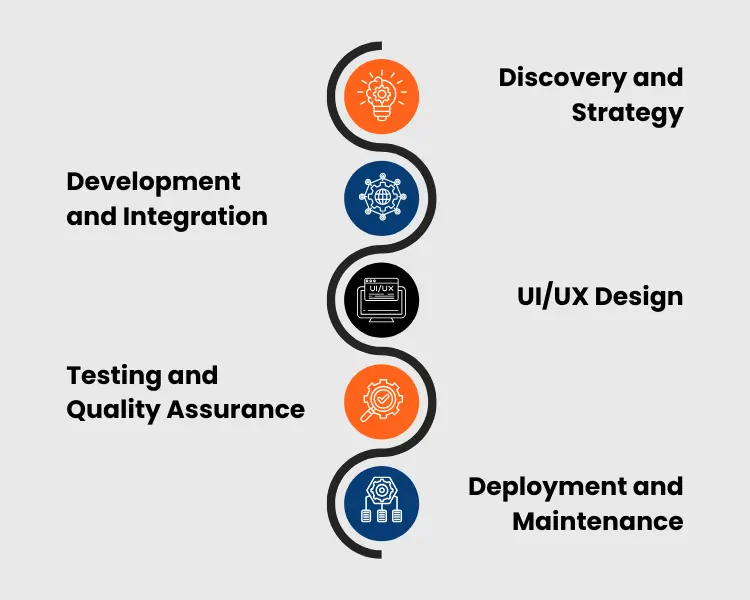
What are the Core Stages of Modern App Development?
The modern software development lifecycle is a structured, collaborative process that results in a high-performing product with minimal quality issues.
1. Discovery and Strategy
Every project starts with defining objectives, identifying target audiences, and mapping out desired outcomes. This phase gives the
development team a clear, customer-centric direction that shapes everything that follows.
2. UI/UX Design
Designers build wireframes, prototypes, and interactive models that define the user journey. Every element — colors, typography, imagery, and layout — is carefully considered to deliver intuitive UI/UX design services that make the product feel natural to use.
3. Development and Integration
This is where the actual coding happens. For products that need to work across multiple platforms, cross-platform app development ensures consistent performance on Android, iOS, and web environments through shared codebases.
4. Testing and Quality Assurance
Before any deployment, rigorous testing catches bugs, security vulnerabilities, and performance bottlenecks. Automated and manual testing for usability, load handling, and security ensures the product is rock-solid at launch.
5. Deployment and Maintenance
After thorough testing, the app goes live through the appropriate platforms. Application modernization services continue beyond launch, keeping the software updated with the latest technologies and security patches.
What Technologies Power the Most Successful Modern Apps?
A successful app needs more than good functionality — it requires a strong foundation of security and efficiency. Top application development companies rely on frameworks like React Native, Flutter, and Angular to build fast, reliable frontends, while robust backend systems form the backbone of every product. This combination of proven technologies is what separates high-quality software from the rest.
Cloud platforms like AWS, Azure, and Google Cloud are now essential for
mobile app development services. They provide elastic scaling, secure data storage, and built-in analytics that accelerate the entire development process. Serverless architecture further allows teams to optimize resource usage and significantly reduce operational overhead.
AI and machine learning are increasingly shaping how modern apps behave. From personalized recommendations and predictive analytics to intelligent automation, these technologies power smarter, more engaging user experiences that keep customers coming back.
What Impact Does Innovation Have on Customer Engagement?
Innovation is the single most important driver of customer engagement. Today’s users expect fast, comfortable, and personalized experiences — and innovation is what delivers on those expectations. Companies that invest in creative development and intuitive interfaces build larger, more loyal customer bases that are far less likely to churn.
One of the most effective ways to meet evolving user needs is through custom
software development services. Features like real-time interaction, personalization engines, and intelligent notifications make communication feel natural and effortless rather than transactional.
Beyond engagement, innovation drives agility. Businesses that continuously adapt to changing market conditions stay ahead of competitors. By modernizing existing applications and integrating emerging technologies, brands keep their digital products current, compelling, and competitive.
What Future Technologies Will Shape the Next Wave of App Development?
Emerging technologies are fundamentally changing how apps are built, deployed, and experienced. These innovations are bringing new levels of intelligence, personalization, and efficiency to the entire development process.
- Artificial Intelligence and Machine Learning: AI goes beyond task automation — it analyzes user behavior, predicts preferences, and automates complex workflows, making applications smarter and more responsive over time.
- Edge Computing: By processing data closer to the user, edge computing drastically reduces latency, enabling real-time app performance and reliability for mission-critical applications.
- Low-Code and No-Code Platforms: These tools empower non-technical stakeholders to collaborate directly in the application development process, accelerating timelines and reducing costs through agile software development practices.
- Augmented Reality and Virtual Reality: Immersive digital environments will transform customer experiences across retail, healthcare, education, and training through richer, more interactive interfaces.
- Blockchain: Enhanced transparency, traceability, and security features will reshape how financial transactions and data integrity are managed within enterprise applications.
Conclusion
In today’s digital landscape, application development companies are the driving force behind how businesses connect with customers, streamline operations, and achieve sustainable growth. They don’t just build apps — they create complete digital ecosystems that enhance brand value, improve customer satisfaction, and boost operational productivity.
Among the leaders in this space, RevInfotech stands out through its commitment to innovation, scalability, and automation. Every solution is tailored to give brands a competitive edge through digital transformation services that align technology with business vision. The result: projects that deliver measurable, long-term impact.