


There was a time when artificial intelligence belonged to science fiction. Today, AI agents are woven into supply chains, customer service, hiring workflows, and financial decision-making across industries. With that kind of reach, AI governance has moved from a nice-to-have to a business requirement.
The truth is simple: AI agents are not passive tools that follow instructions quietly. They process enormous volumes of data, make decisions that affect real people, and operate at a speed no human team can match. Without proper oversight, the risks pile up fast. Biased outputs, data leaks, regulatory fines, and lost customer confidence are just a few examples.
In this blog, we look at why responsible AI governance is the foundation every business needs before scaling AI agents, and how to get it right.
What Makes AI Governance the Missing Piece in Winning With AI Agents?
No matter how capable your AI agents are, they do not come with built-in accountability. An AI model can make a hiring recommendation that discriminates against a protected group, or a chatbot can share sensitive customer data in the wrong context. If no governance structure exists, the business carries the consequences.
A solid AI governance framework sets clear rules for how AI systems are built, tested, deployed, and monitored. It defines who is responsible when something goes wrong. It gives your teams the confidence to experiment and push boundaries because there are safety rails in place.
Think of it this way: governance does not slow you down. It is the reason you can move faster without breaking things. The EU AI Act, which goes into full enforcement in August 2026, will require verifiable documentation, AI risk assessments, and defined accountability chains for high-risk systems. Businesses that build their AI governance framework now will be compliant by default rather than scrambling to catch up.
More importantly, strong AI ethics and governance eliminate the kind of costly mistakes that damage reputation and invite lawsuits. When your AI operates within clearly defined boundaries, the trust between your brand and your customers deepens over time.
What Are the Core Pillars of Effective AI Governance?
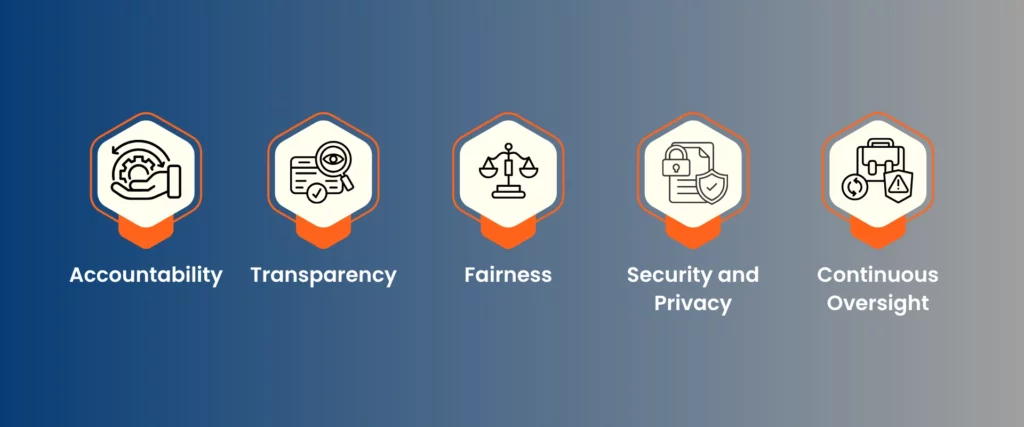
AI may be the most capable technology your business has ever adopted, but capability without discipline is a liability. To make AI work reliably over the long term, your governance structure needs to stand on five core pillars.
1. Accountability
Every AI action should have a clear owner. Whether it is the developer who built the model, the product team that deployed it, or the executive who approved its use, someone must be answerable when AI produces a harmful outcome. Without defined AI agent accountability, problems get passed around and never resolved.
2. Transparency
AI transparency means users and stakeholders can understand why an AI system made a specific decision. If a loan application gets rejected by an AI model, the applicant deserves to know the reason. Opaque AI creates suspicion. Explainable AI builds trust. In 2026, regulators are moving toward mandatory explainability for high-risk use cases, especially in credit scoring, healthcare, and public services.
3. Fairness
AI bias detection must be built into your development pipeline, not treated as an afterthought. Models trained on biased data will produce biased results, and those biased results can damage lives. Effective governance includes regular audits to ensure AI outputs are fair across demographics, especially in hiring, lending, and access to public services.
4. Security and Privacy
AI systems process massive amounts of personal and proprietary data. AI data privacy is not optional. Governance must ensure that sensitive information is encrypted, access-controlled, and monitored continuously. The goal is to prevent data misuse before it happens, not react after a breach.
5. Continuous Oversight
AI models drift over time. A model that performed well six months ago may produce unreliable results today because the underlying data patterns have shifted. AI model monitoring ensures you catch these changes early, recalibrate when needed, and maintain the quality your users expect. This is not a one-time audit. It is an ongoing practice.
How Do AI Governance Tools Build Trust and Growth Together?
Trust and growth are not opposing forces. In fact, they depend on each other. Customers engage more deeply with businesses whose AI systems are transparent and predictable. When people know that a company takes AI risk management seriously, they are more willing to share data, try AI-powered features, and recommend the brand to others.
On the growth side, strong governance protects businesses from financial risk. The cost of an AI-related data breach, a discrimination lawsuit, or a regulatory fine can easily reach millions. Investing in AI governance tools and frameworks upfront is far cheaper than paying for mistakes later.
There is also a competitive angle. Businesses that demonstrate responsible AI governance attract better talent, stronger partnerships, and more favorable terms from investors. In a market where AI adoption is accelerating across every sector, governance is what separates the companies that scale safely from those that crash under the weight of their own technology.
Why Should Businesses Prioritize AI Governance Best Practices Right Now?
The regulatory landscape is shifting fast. The EU AI Act reaches full enforcement in 2026. In the United States, states like Colorado, California, and New York are advancing their own AI compliance frameworks. Waiting is no longer a viable strategy. Here is why AI governance best practices deserve immediate attention:
- Prevent Future Risks: Proactive monitoring catches problems before they become public crises. Regular audits, model cards, and data lineage documentation reduce the odds of a costly failure.
- Strengthen Customer Trust: Transparent AI practices make customers more confident in your products. Trust is a competitive advantage that compounds over time.
- Enable Safer Innovation: When governance guardrails are in place, your teams can experiment with new AI capabilities without the fear of unintended consequences.
- Gain a Competitive Edge: Early adopters of governance standards are better positioned to win contracts, especially in regulated industries like finance, healthcare, and government.
- Support Long-Term Growth: AI systems built on strong governance foundations are more resilient, more compliant, and easier to scale as your business grows.
Ready For Digital Transformation?
Grow your business with advanced technology and expert digital solutions.
You have a vision. We can help you achieve it.
Bring your vision to life with our expert team. As a global leader, we pave the way in the new era, bringing your ideas to fruition. Partner with us to make your vision a success.
Conclusion
AI governance is not a checkbox exercise. It is the operational backbone that makes AI agents safe, reliable, and ready for enterprise use. With the right frameworks covering accountability, transparency, fairness, security, and ongoing oversight, businesses can unlock the full potential of AI without exposing themselves to unnecessary risk.
At Revinfotech, we help businesses integrate AI solutions that are built on strong governance from day one. Whether you need help designing an AI governance framework, setting up AI model monitoring, or preparing for regulatory compliance, our team has the experience to guide you through it. Reach out to us to make responsible AI an asset, not a liability, for your business.
Frequently Asked Questions
What is AI governance in simple terms?
+
AI governance is the set of rules, policies, and practices that guide how artificial intelligence is developed, deployed, and monitored within an organization. It covers everything from data handling and bias prevention to accountability and regulatory compliance.
Why do businesses need AI governance?
+
Without governance, AI systems can produce biased outcomes, leak sensitive data, or violate regulations. Governance reduces these risks while building customer trust and ensuring your AI investments deliver reliable, long-term value.
Does AI governance slow down innovation?
+
Not at all. Governance actually enables faster innovation by creating a safe environment for experimentation. When teams know there are guardrails in place, they can push harder on new ideas without worrying about unintended consequences.
Who is responsible for AI governance in a company?
+
Responsibility is shared across the organization. Leadership sets the strategy, developers implement safeguards, compliance teams monitor adherence, and end-users report issues. Many enterprises are now forming dedicated AI risk committees at the board level.
How does AI governance create business value?
+
It prevents costly mistakes like fines, lawsuits, and data breaches. It also builds customer trust, attracts better partnerships and talent, and positions the business to scale AI safely in a tightening regulatory environment.

Article written by
Ashwani Kumar
Ashwani Kumar is an SEO Team Lead & Project Manager at RevInfotech with 4+ years of experience in driving sustainable organic growth across competitive digital markets. He specializes in on-page, technical, off-page, and local SEO, focusing on improving ...Read More
Inspired by These Insights? Let’s Talk.
From understanding trends to building solutions, we're here to help you take the next step. Our experts are ready to guide your digital transformation.


