


Web3 has unfolded new prospects toward a decentralized Web, replete with the most modern development tools. Moving further into the second half of 2026, knowing the right set of Web3 development tools will be essentially indispensable to anyone looking forward to building strong, innovative decentralized applications. These tools are the very backbone of web3 app development and are instrumental in carving out the future of the Internet.
By the end of the year, every developer should be familiar with the top ten web3 development tools, which we will talk about in this blog. From working with established web3 development platforms to experimenting with newer technologies, these tools will help you get around all the pitfalls and snafus inherent in decentralized development. We will also cover how major players like Google Cloud Web3 are taking care of the ecosystem.
For those who have partnered with a web development company or are independent entrants into this space, knowledge of tools becomes critical to staying competitive. Be it developing secure smart contracts or scalable decentralized applications, the real power of Web3 comes into play with these tools.
What are the Must-Have Web3 Development Tools for 2026?
As the landscape of Web3 development continues to change, even in 2026, the need for the right Web3 development tools will become more critical than ever. These development tools will help developers build safe, scalable, and efficient dApps. Ranging from frameworks designed to ease the process of web3 app development to platforms that provide strong infrastructure, these development tools are just the tip of what forms any successful Web3 project base.
Must-have web3 development tools include an integrated development environment for developing, debugging, and deploying smart contracts. These tools make the development process easier for both individual developers and teams at any web3 development company. Further, the integration of cloud services such as Google Cloud Web3 makes it possible to ensure that complex decentralized applications have the required scalability and reliability, hence forming an important feature in the developer’s toolkit.
Moreover, selection criteria across web3 development platforms only play a huge role in making one project successful over the other. Those with vast libraries, proper documentation, and community support are of much help in their own right. Such platforms not only accelerate the development process but also ensure that developers can create fresh solutions in response to a rapidly growing Web3 ecosystem.
Top 10 Web3 Development Tools
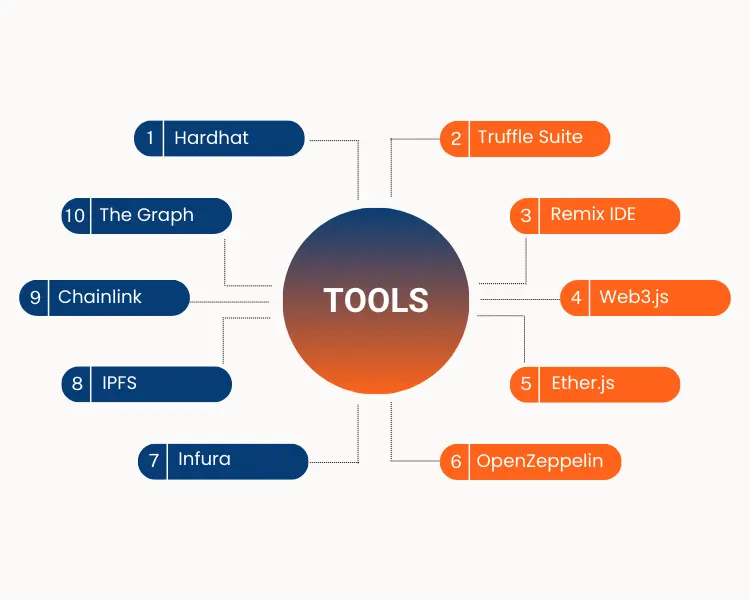
1. Hardhat
Hardhat is a development environment for Ethereum. It’s a powerful framework for building, testing, and deploying smart contracts; it has plugins and debugging tools and is easy to integrate with other libraries.
2. Truffle Suite
Truffle Suite is a full-development framework for Ethereum. In addition to including Ganache, a personal blockchain for developers, it simplifies the compilation, deployment, and testing of smart contracts.
3. Remix IDE
Remix is an online environment for creating Ethereum smart contracts. It has the support of Solidity and Vyper languages that let developers write, compile, and debug the contracts within a browser.
4. Web3.js
A JavaScript library called Web3.js is used to communicate with the Ethereum blockchain. Through the use of this library, web applications can send and receive data from the blockchain as well as use smart contracts.
5. Ether.js
Ether.js is a lightweight, modular library interacting with the Ethereum blockchain. It focuses on usability and security, with tools for wallet management, transaction processing, and blockchain connectivity.
6. OpenZeppelin
An array of safe, reusable smart contracts is provided by OpenZeppelin. This includes implementations of widely-used ERC standards whereby a developer could build secure and efficient contracts without reinventing the wheel.
7. Infura
Infura provides scalable Ethereum infrastructure that gives developers the ability to hook into the Ethereum network without running their nodes. As a result, it makes interacting with Ethereum and IPFS easier using APIs, which makes it easy to integrate into dApps.
8. IPFS (InterPlanetary File System)
A decentralized system for sharing and storing files is called IPFS. It provides the developer with a way to store and share files on a distributed network—a very integral part of building decentralized applications (dApps).
9. Chainlink
Chainlink is a decentralised oracle network that acts as an interface between smart contracts and real-world data. Effectively, it bridges blockchain with real-world data to make the latter accessible reliably to the former for decentralized applications.
10. The Graph
The Graph is a decentralized protocol to index and query blockchain data. It allows developers to create and query APIs—what’s called subgraphs—by organizing data from smart contracts to make building and scaling decentralized applications much easier.
Ready For Digital Transformation?
Grow your business with advanced technology and expert digital solutions.
Conclusion
Therefore, with the ever-changing Web3 landscape, these top 10 web development tools have become a must-have for developers targeting building safe, scalable, and innovative decentralised applications. Ranging from full-fledged frameworks like Hardhat and Truffle Suite to necessary infrastructure providers like Infura and IPFS, each of these tools serves as an essential cog in the development process.
Mastering these tools by the end of 2026 will be instrumental in traversing all the pitfalls and opportunities of decentralized development, making sure that developers are well-armed and able to contribute to the future of the Internet.
Moreover, RevInfotech is at the forefront of integrating Web3 technologies into the healthcare industry, driving innovation at an accelerated pace. Our expertise empowers healthcare organisations to improve data integrity, reduce administrative burdens, and streamline compliance processes. By leveraging Web3 development tools, healthcare providers can efficiently meet regulatory requirements while maintaining the highest standards of patient care and data security.
Frequently Asked Questions
How does the Future Web3 impact everyday internet use?
+What are the benefits of adopting Web3 solutions?
+In what ways can businesses use decentralised applications.
+Why is it key to the Future Web3?
+
Navdeep Garg, CEO of Revinfotech
I'm founder and CEO of Revinfotech Inc. I traits in leadership and brilliant practitioner in the Financial Services and FinTech. I helped ban in connecting to the FinTech ecosystem through payment acceptance in blockchain as a service and even help i... read more