


Top 15 Mobile App Trends in 2026
Mobile applications continue to be a driving force across industries, helping businesses grow and deliver new levels of convenience to their users. The technology has helped brands of all sizes build strong reputations and stay visible in a competitive market.
While trends in the tech world come and go, mobile apps are not losing steam. In 2026, app usage is still climbing, and the opportunities for businesses to reach customers through mobile are only expanding.
If you are looking for the mobile app trends that matter most right now, this list covers the ones worth paying attention to. Here are the top 15 mobile app trends in 2026.
Top Mobile Trends Shaping 2026
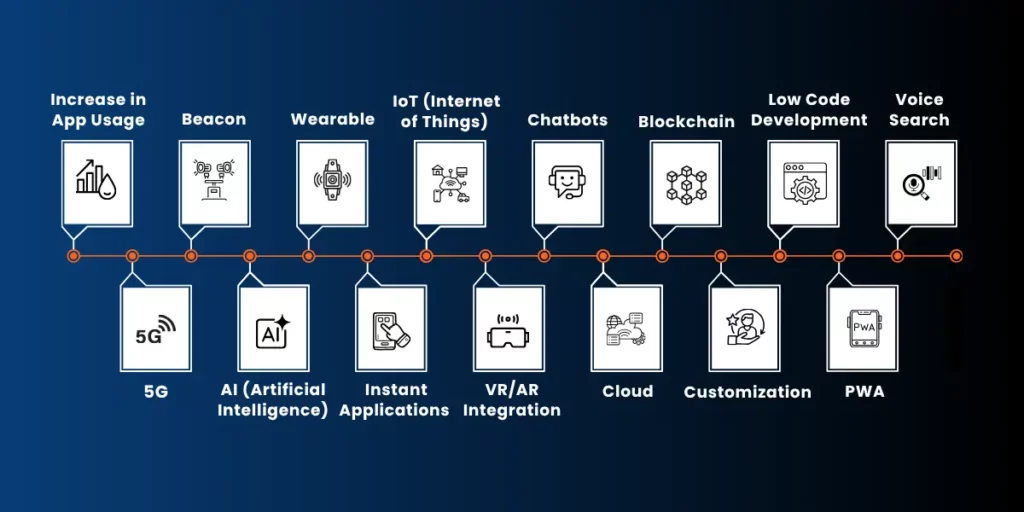
1. Increase in App Usage
Mobile app usage has been growing steadily year after year. People now spend a significant portion of their day inside apps for work, shopping, communication, and entertainment.
In 2026, that momentum is stronger than ever. The global market crossed 257 billion app downloads in recent years, and revenue projections suggest the industry will generate over $613 billion by year end. Having a mobile app for your business is no longer optional. It is a requirement if you want to stay relevant and accessible to your audience.
2. 5G
The arrival of 5G is one of the most talked-about mobile app development trends in recent years, and for good reason. Faster download speeds, minimal latency, and more reliable connections are changing how users interact with apps.
With 5G becoming widely available, industries like gaming, augmented reality, and virtual reality are seeing real improvements in user experience. For app developers, 5G opens the door to building features that were not practical on slower networks, including real-time collaboration, high-definition streaming, and richer in-app content.
3. Beacon
Beacon technology bridges the gap between the digital and physical world, and it is especially valuable in retail. By sending location-based notifications and offers to nearby users, beacons help businesses deliver personalized experiences at the right moment.
Beyond retail, the healthcare and hospitality industries also benefit from beacon integration. Whether it is indoor navigation in a hospital or proximity alerts in a hotel, this technology adds a layer of convenience that users appreciate.
4. AI (Artificial Intelligence)
AI in mobile apps has moved well past the experimental stage. In 2026, artificial intelligence powers everything from personalized content recommendations and voice assistants to predictive search and smart automation. The technology is deeply embedded in how modern apps function.
What makes AI especially relevant now is how accessible it has become. Even smaller development teams can integrate machine learning models into their workflows. Businesses that build AI into their mobile app development process can deliver faster, smarter, and more intuitive experiences to their users.
5. Wearable
Smart wearables deserve their own spotlight among the latest mobile app trends. Devices like smartwatches, fitness bands, and health monitors depend on companion mobile apps to deliver their full value.
Cross-platform app development plays a big role here, since wearable apps need to work across different operating systems and hardware configurations. In 2026, major brands continue investing in wearables, and the demand for well-built companion apps is growing alongside them.
6. Instant Applications
Instant apps solve a real problem for users who are short on device storage. These lightweight applications let people try an app without installing it, which removes a major friction point from the user journey.
The key benefits include no installation required, compact file size, integrated website functionality, and zero device storage use. For developers, instant apps can serve as a trial experience that leads to full installations, improving conversion rates without forcing users to commit upfront.
7. IoT (Internet of Things)
IoT app development continues to expand as connected devices become a standard part of daily life. The global IoT market was valued at roughly $213 billion in recent years and is forecast to reach over $621 billion by 2030, with mobile apps generating a significant share of that revenue.
From smart home controls and industrial sensors to connected vehicles and agricultural systems, the use cases keep growing. Sectors like education, healthcare, and city infrastructure now rely on IoT-connected mobile apps to run key operations.
8. VR/AR Integration
The eCommerce market has been evolving quickly, and its next phase involves deeper AR VR mobile apps integration. Retailers already use AR to let customers visualize products before buying. Apps like IKEA Place and Google Lens have shown how practical this technology can be in everyday scenarios.
While AR and VR apps are still more common in gaming and retail, their use across education, real estate, and healthcare is accelerating. With devices like Apple Vision Pro entering the market, this trend is moving from niche to mainstream faster than expected.
9. Chatbots
Industry estimates suggest that a majority of businesses now use chatbots on their websites and apps to handle initial customer queries. The reasoning is simple: offering around-the-clock manual support is expensive and hard to scale.
Chatbot app development has matured considerably. Modern chatbots use natural language processing to understand context, provide helpful answers, and hand off complex issues to human agents when needed. They reduce support costs, improve response times, and keep users engaged even outside business hours.
10. Cloud
Mobile cloud computing remains one of the most practical app development trends for businesses of all sizes. Cloud-based apps reduce the need for on-device storage, improve collaboration, and scale more easily as user demand grows.
The global mobile cloud market is projected to reach $202.4 billion by 2028. Key developments shaping the space include hybrid cloud services, the continued growth of cloud solutions for mobile workloads, and early-stage integration of quantum computing into cloud platforms.
11. Blockchain
Blockchain mobile apps are gaining traction as the technology moves past its early hype cycle. The sector is now focused on real utility: secure transactions, decentralized identity, supply chain transparency, and tamper-proof record keeping.
As more businesses explore blockchain integration within their mobile products, the market continues to grow steadily. For industries like finance, healthcare, and logistics, blockchain adds a trust layer that traditional systems cannot match.
12. Customization
Personalization has become a baseline expectation in mobile apps. Users want content, offers, and experiences tailored to their preferences, and businesses that deliver on that expectation see stronger engagement and retention.
This trend is not limited to eCommerce. Education apps, finance platforms, and health apps are all building personalized user journeys. The data backs it up: users are far more likely to stay active in an app that adapts to how they use it.
13. Low Code Development
Low code app development is one of the biggest shifts in how mobile apps get built. As development costs rise, businesses are turning to low code and no code platforms to build functional apps faster and at lower cost.
These platforms allow teams with limited technical resources to prototype, launch, and iterate on apps without relying entirely on full-stack development teams. In 2026, low code adoption is growing across industries, and the tools themselves are becoming more capable every quarter.
14. PWA
Progressive web apps continue to gain ground as a cost-effective alternative to native app development. PWAs work offline, support push notifications, and deliver a user experience that closely resembles a native application, all through a web browser.
First introduced around 2015, PWAs have now been adopted by companies across industries. Their appeal is straightforward: wider reach, lower development costs, and no dependency on app store approvals. As mobile traffic keeps growing, PWAs offer a practical path for businesses that want a strong mobile presence without maintaining separate native apps.
15. Voice Search
Voice search and smart assistants are among the fastest-growing mobile technology trends in 2026. Users increasingly prefer speaking over typing, especially for quick searches, hands-free commands, and on-the-go tasks.
Apps that integrate voice user interfaces can reach users in moments when typing is not convenient, like while driving or cooking. With natural language processing improving rapidly, voice-enabled features are becoming more accurate, responsive, and useful across all app categories.
Ready For Digital Transformation?
Grow your business with advanced technology and expert digital solutions.
You have a vision. We can help you achieve it.
Bring your vision to life with our expert team. As a global leader, we pave the way in the new era, bringing your ideas to fruition. Partner with us to make your vision a success.
Wrapping Up
Mobile applications have firmly established themselves as essential tools for business growth. They offer convenience, direct access to customers, and a strong platform for promoting your products or services.
The 15 mobile app trends covered in this post represent real shifts in how apps are built, used, and valued. Whether you are investing in AI, exploring low code platforms, or planning an IoT-connected product, staying informed on the latest mobile app trends will help you make smarter decisions and put your resources to work where they matter most.
Frequently Asked Questions
What are the top mobile app trends in 2026?
+
The most important trends include AI-powered features, 5G-optimized experiences, progressive web apps, AR/VR integration, and stronger data privacy. These trends focus on improving speed, personalization, and user engagement across devices.
Why are super apps gaining popularity?
+
Super apps combine multiple services like payments, shopping, messaging, and booking into a single platform. Users prefer the convenience of having everything in one place, especially in regions where storage and data costs are a concern.
How is AI impacting mobile app development in 2026?
+
AI enables smarter personalization, voice recognition, chatbot interactions, and predictive features. It helps apps learn user behavior and deliver relevant content and recommendations in real time.
Is AR/VR technology becoming mainstream in mobile apps?
+
Yes. AR and VR are now used in retail, gaming, education, and real estate apps. Users can visualize products, explore immersive environments, and interact with content in ways that were not possible a few years ago.
How are mobile apps adapting to increased privacy concerns?
+
Apps now offer transparent permission systems, encrypted data handling, and compliance with privacy regulations like GDPR. Users want more control over their personal data, and developers are building apps with trust and transparency at the core.

Article written by
Navdeep Garg, CEO of Revinfotech
<p>I am the founder and CEO of Revinfotech Inc., with over 15 years of experience in leadership, financial services, FinTech, technology, and business management. I am a strategic business leader and hands-on practitioner with a strong track record of buildin ...Read More
Inspired by These Insights? Let’s Talk.
From understanding trends to building solutions, we're here to help you take the next step. Our experts are ready to guide your digital transformation.


