



Cloud-native application development seemed to have introduced new ways of developing and deploying applications, scaling up in ways quite unimaginable. Additionally, businesses are advancing toward cloud-native application platforms. There is still a constant need for scalable, highly resilient solutions. The evolution along these lines smacks of a transformative shift in software development; it opens the doors to new approaches and new possibilities.
Over the coming years, building cloud-native applications on platform capabilities, such as Azure, will drive higher performance and flexibility within an organizational strategy. Cloud-native application development on Azure allows the enterprise to build responsive, robust, fast-moving solutions to adapt to demand within the ever-changing market. Agility ensures these organizations are ahead of the pack within this ever-changing technology environment.
Simultaneously, the rise of cloud-native, low-code application development further democratizes the software development process, enabling even the most meagerly skilled coders to build feature-rich apps. This is likely to pick up the rate of innovation and, ultimately, ensure that cloud-native technologies are within reach for enterprises of all sizes. With its development, cloud-native development can see a day when improved applications will be developed and put on the market with efficiency, speed, and ease unimaginable in today’s world.
How Are Cloud-Native Application Platforms Evolving?
Nowadays, cloud-native application platforms continue to evolve with the emerging demands of businesses today and extend even more excellent ways of approaching the development of cloud-native applications. From basic scalability and flexibility to improved-level capabilities, making it quite easy to construct cloud-native apps, are what the modern cloud-native app platform will have. It includes containerization, microservices, and orchestration tools like Kubernetes; it helps developers rapidly deploy and manage applications across diverse environments.
It takes cloud-native, low-code application development to an extreme where even non-improved programmers can contribute to application development. The theme of creativity becomes much wider with more developers creating, adapting, and deploying applications swiftly. Low-code methods reduce time-to-market and boost productivity with the offering of collaboration between business and IT, while cloud-native applications will be far more accessible and agile.
Leading platforms, such as Azure, go even further in expanding the bounds of such developments with the stretched limits on cloud-native application development. On these premises, cloud-native application development on Azure exposes a complete suite of tools and services that make the development of complex apps less cumbersome. Indeed, these developments guarantee that scaling up and changing according to market fluctuation by different organizations is justified, with newer technology being the guarantee for growth and productivity within the competitive digital space.
What Are the Key Trends in Building Cloud-Native Applications?
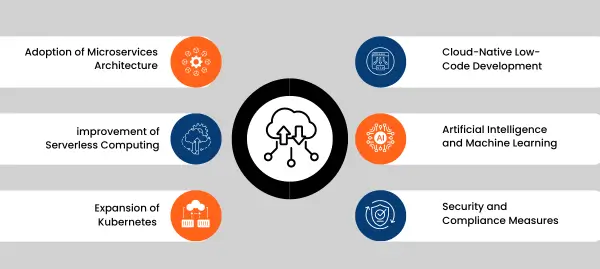
1. Adoption of Microservices Architecture
Microservices are building blocks for developing cloud-native applications. This makes it possible for developers to create these kinds of applications as a group of loosely connected services. The idea has been taken to be effective in its flexibility, with great scalability properties and ease of maintenance.
2. Improvement of Serverless Computing
The serverless computing utilized, one after another, in cloud-native application platforms, gives developers the capability to run code without managing the servers. This provides infrastructure overhead taken away from teams to focus on building features rather than resource management.
3. Expansion of Kubernetes
That has created Kubernetes as a de facto standard for the orchestration of containerized applications, consequently driving cloud-native application development. It is impossible to replace it with heavyweight features like scalability, observability, and automation in deploying procedures while developing cloud-native applications.
4. Cloud-Native Low-Code Development
Cloud-native low-code application development is a process of creating modern and improved applications with the least coding. It extends your developer base and accelerates the time to market for developing line-of-business-critical applications.
5. Artificial Intelligence and Machine Learning
AI and ML capabilities quickly turn into the mainstream for cloud-native application development, making applications more informed and adaptive. This smooth integration of technologies into cloud-native solutions is possible with the help of platforms such as Azure for cloud-native application development.
6. Security and Compliance Measures
As cloud-native applications process increasingly important information, this now brings a new sense of urgency for structured security. New security frameworks and compliance tools that are built into cloud-native application platforms are proliferating data protection and ensuring the fulfilment of regulatory policies, which increasingly makes cloud-native environments safer for enterprises.
How Can Low-Code Platforms Transform Cloud-Native Development?
Because it makes the process of developing complex applications simpler and faster, low-code, cloud-native application development is revolutionizing the way businesses approach creating cloud-native applications. It enables developers to create cloud-native applications with a minimum effort in coding by exploiting user interfaces and prebuilt elements. Correspondingly, with low code, cloud-native solutions become much more accessible to a wider audience of businesses and developers alike, thereby driving innovation and efficiency by reducing the time and expertise required to develop and deploy applications.
- Increased Collaboration: These platforms allow the business stakeholders and developers to collaborate so that applications meet both technical and business requirements.
- Lower Development Costs: A low-code cloud-native application development framework reduces the necessity of possessing deep coding skills that are associated with extra costs of development—letting organizations effectively utilize all available resources.
- Scalability: Low-code platforms are designed to meet the scalability demands of cloud-native application environments, wherein organizations can scale up applications to meet their ever-expanding needs
- Integration with Existing Systems: Many low-code platforms, especially cloud-native application development environments like Azure, allow for this by design while extending functionality without reconfiguring much, if at all, from the on-premise enterprise systems.
- Enhanced Security and Compliance: Safety capabilities and compliance tools across the low-code platforms will secure data, making sure that cloud-native apps confirm continuous industry standards and legislative needs.
Ready For Digital Transformation?
Grow your business with advanced technology and expert digital solutions.
Conclusion
The future of developing cloud-native applications will be characterized by improvement, flexibility, and availability. Indeed, it is the application platforms for cloud-native applications that, with their growing feature of low-code development, microservices, and serverless computing, can only lead organizations toward better efficiencies, scalability, and security in their applications. Full use of technologies like Kubernetes, laced with AI and machine learning, would add power to make cloud-native applications intelligent and adaptive.
Moreover,Revinfotech is pioneering the integration of cloud-native technologies into the app development landscape at a rapid pace. Our expertise empowers organizations to improve application performance, reduce infrastructure complexity, and accelerate deployment processes. By leveraging cloud-native development, businesses can efficiently adapt to market changes while maintaining high standards of scalability, reliability, and security. This approach allows companies to meet evolving customer needs and drive innovation, ensuring that their applications remain at the forefront of the competitive digital landscape.
Frequently Asked Questions
What is cloud-native app development?
+How will cloud-native application platforms evolve in the future?
+What role does low-code development play in cloud-native applications?
+Why is Kubernetes important for cloud-native app development?
+
Navdeep Garg, CEO of Revinfotech
I'm founder and CEO of Revinfotech Inc. I traits in leadership and brilliant practitioner in the Financial Services and FinTech. I helped ban in connecting to the FinTech ecosystem through payment acceptance in blockchain as a service and even help i... read more