


In a fast-moving digital world, blockchain applications are working their way into the very fabric of industries by offering decentralised and secure solutions. However, they are not immune to cyber risks. Emerging threats in blockchain, including sophisticated hacking techniques and protocol vulnerabilities, require proactive strategies to mitigate them. Advanced blockchain security strategies are needed to protect sensitive data on blockchain networks and to maintain trust.
Addressing blockchain application cybersecurity challenges is important to ensure reliability. As reliance on blockchain continues to grow, identifying and mitigating blockchain vulnerabilities is essential. Advanced blockchain security strategies, such as encryption and strong identity verification, are very important measures to ensure blockchain networks‘ security. Knowing what security measures blockchain offers helps businesses stay one step ahead of evolving threats.
Moreover, the intersection of blockchain and cyber threats calls for innovative solutions. Emerging threats in blockchain require organisations to adopt state-of-the-art approaches for protection. Advanced blockchain security strategies can be authority, and blockchain vulnerabilities and mitigations can be addressed to make a difference in the security of blockchain applications. These efforts guarantee resilience against evolving cyber risks and reinforce trust among stakeholders.
What Emerging Threats Are Targeting Blockchain Networks Today?
The increasing adoption of blockchain applications has attracted attention from cybercriminals, resulting in sophisticated threats. First, the vulnerabilities in smart contracts are under attack. where attackers take advantage of flaws in the code to manipulate transactions. Moreover, phishing schemes and credential theft target users within blockchain networks. Securing blockchain networks requires proactive measures to counter such threats and ensure system integrity.
Second, blockchain vulnerabilities and mitigations have to deal with the rise of 51% of attacks, in which hackers take majority control of a network. The emerging threats in blockchain include side-channel attacks, where sensitive data is extracted through computational leaks. Furthermore, security measures for blockchain are vital to protect against these threats and maintain operational continuity.
Moreover, the supply chain attacks on blockchain systems have disrupted decentralized operations. Cybersecurity challenges in blockchain extend to decentralized finance platforms that are always under attack for fraud and manipulation. In this perspective, advanced blockchain security strategies and blockchain vulnerabilities and mitigations are very important.
What Are the Cybersecurity Challenges in Blockchain?
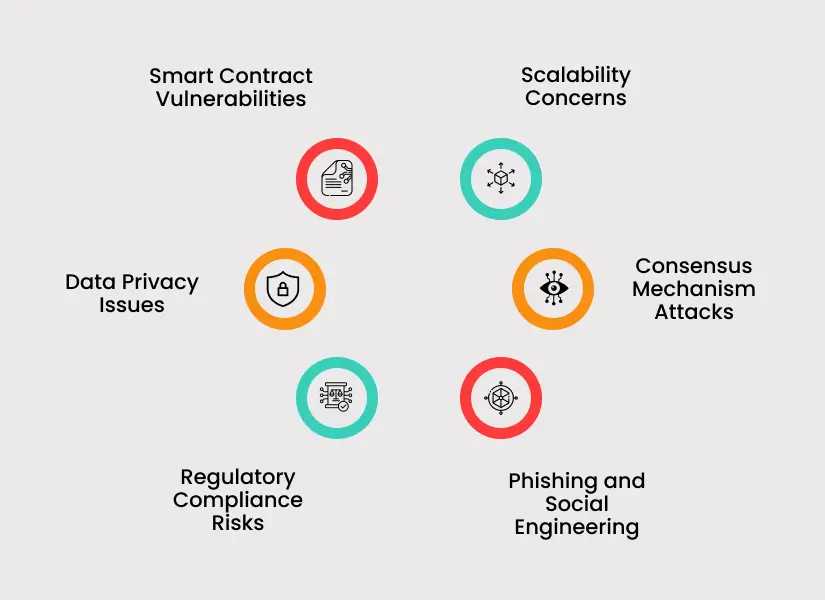
1. Smart Contract Vulnerabilities
Smart contracts are self-executing programs that usually have coding flaws. These vulnerabilities can be utilised by attackers to manipulate transactions or drain funds. Besides, the security of blockchain networks requires rigorous testing and regular updates to mitigate risks. Advanced blockchain security strategies, such as formal verification, help to handle these challenges effectively.
2. Scalability Concerns
Blockchain applications are significantly challenged by scalability issues due to their resource-intensive operations. This creates susceptibility to denial-of-service attacks. Further, security measures for blockchain could help mitigate these threats. Sharding is one such solution being developed to improve the scalability of blockchain without compromising security.
3. Consensus Mechanism Attacks
Consensus mechanisms like Proof of Work or Proof of Stake are very essential for blockchain operations but are often under attack. For instance, a 51% attack can compromise the whole network. Therefore, solid protocols and decentralization are essential to prevent such attacks.
4. Phishing and Social Engineering
Phishing attacks and social engineering are common methods to exploit user trust and steal credentials. Blockchain and cyber threats are amplified when attackers target weak user authentication systems. Educating users and employing two-factor authentication can significantly reduce these risks.
5. Regulatory Compliance Risks
Cybersecurity challenges in blockchain include adhering to evolving regulatory frameworks. Non-compliance can expose systems to penalties and attacks. Additionally, advanced blockchain security strategies ensure adherence to legal standards, reducing exposure to vulnerabilities.
6. Data Privacy Issues
Blockchain vulnerabilities and mitigations must address concerns about exposing sensitive user data. Public blockchains, in particular, face challenges in balancing transparency with privacy. Furthermore, encryption techniques and zero-knowledge proofs can protect user data effectively.
How Do Blockchain Applications Stay Resilient Amid Evolving Cyber Threats?
In a broader sense, blockchain applications are resilient against cyber threats through the use of strong security frameworks and proactive strategies. First, advanced blockchain security strategies protect systems from new emerging threats. The following are the elements included in addressing vulnerabilities: regular updates, security audits, and monitoring tools. One can only secure blockchain networks by paying attention to the technological frameworks and increasing the awareness of users to reduce risks. Compliance with regulatory standards is also very important in mitigating legal and security challenges.
Key Strategies for Resilience:
- Implement Multi-Signature Wallets: Multi-signature wallets improve security by requiring multiple approvals for transactions, minimizing risks.
- Perform Routine Security Audits: This helps to identify vulnerabilities and thus reduce risks related to blockchain and cyber threats.
- Adopt Real-Time Monitoring: Real-time tracking tools help detect suspicious activities, ensuring rapid response.
- Improve User Education: Educating users about phishing and credential safety reduces cybersecurity challenges in the blockchain.
- Strengthen Consensus Protocols: Improved protocols prevent 51% of attacks, enhancing the integrity of blockchain applications.
- Comply with Regulations: Adherence to legal standards minimises risks of blockchain vulnerabilities and mitigations.
Ready For Digital Transformation?
Grow your business with advanced technology and expert digital solutions.
Conclusion
In the final analysis, blockchain applications can only realise their true potential if underpinned by strong cybersecurity frameworks. Additionally, there is a very essential need to address blockchain vulnerabilities and mitigations in this space for resilience. By adopting state-of-the-art blockchain security strategies and security measures for blockchain, organizations can navigate emerging threats in blockchains effectively to ensure operational integrity and trust.
Moreover, RevInfotech is spearheading the improvement of blockchain applications with advanced cybersecurity strategies. Our expertise empowers businesses to secure blockchain networks, mitigate vulnerabilities, and address emerging threats in blockchain. By implementing advanced blockchain security strategies, companies can ensure compliance, improve operational resilience, and protect sensitive data while navigating the challenges of evolving cyber threats.
Frequently Asked Questions
Why is cybersecurity crucial for blockchain applications?
+What are the top emerging threats in blockchain?
+How can businesses secure their blockchain networks?
+What are the benefits of advanced blockchain security strategies?
+
Navdeep Garg, CEO of Revinfotech
I'm founder and CEO of Revinfotech Inc. I traits in leadership and brilliant practitioner in the Financial Services and FinTech. I helped ban in connecting to the FinTech ecosystem through payment acceptance in blockchain as a service and even help i... read more