Over the past few months, if you have not been completely aloof of tech trends, you would certainly have come across the topic of AI SaaS very often. Moreover, it is not just a case of making noise. Teams that were once very busy with lengthy and complex processes of pulling reports, chasing data, or juggling between different tools have now been shifted to the use of intelligent platforms.
It does not matter whether you are running a startup, a mid-sized company that is growing, or a traditional business that is trying to modernise. Some tools fit right into what you already use such as CRMs, marketing platforms and analytics dashboards, making everything a little smarter and a lot more upgrade, all quiet and invisible.
We will illustrate the various ways companies are using it to save time, reduce costs, and delight customers, as well as to make better decisions, further not necessarily needing a data science team on payroll. In the end, you will have a clear picture of future trends and how to start adopting these tools to stay ahead of your competitors.
How AI SaaS Accelerates Decision-Making With Real-Time Insights in 2025?
AI-enabled systems can sort through vast data sets within seconds, converting raw digits into obvious signals. Rather than executives monitoring weekly reports or manual data processing, the dashboards instantaneously show the updates of trends, irregularities, and forecasts. However, SaaS AI solutions enable teams to clearly understand the current landscape, anticipate what is likely to happen next, and determine which actions will deliver the greatest impact.
Moreover, the systems minimise human errors. In turn, their algorithms detect behaviours that are too faint or intricate for human scrutiny, such as gradual changes in consumer buying habits or signs of customer attrition. The systems can evaluate risks, prioritise opportunities, and recommend actions based on the past performance of similar cases. Thus, the decision-makers receive fewer guesses and more proof.
Most importantly, AI-based SaaS systems are gradually becoming smarter. Feedback loops, including win/loss data, campaign results, or customer support, allow the system to keep improving the recommended actions with each iteration. Consequently, the decision engine becomes faster, more precise, and closely integrated with company objectives month after month.
How AI SaaS Helps Brands Personalise at Scale Across Every Touchpoint?
The latest technologies make use of machine learning saas capabilities as a service in order to study human behaviour, preferences, and circumstances in real-time over a huge number of interactions.
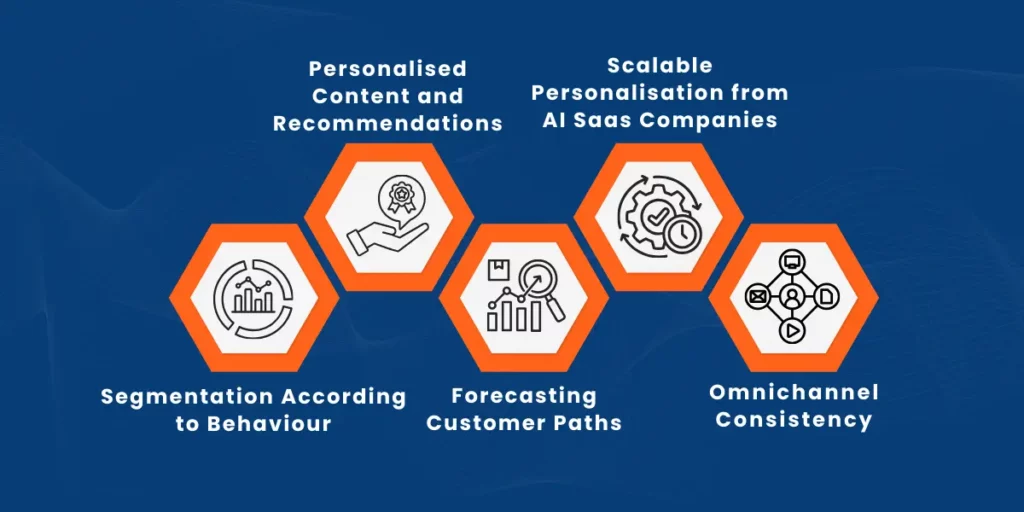
1. Segmentation According to Behaviour
The systems classify the customers according to their real actions, which include clicks, purchases, and engagement levels, rather than just by their static demographics. As a result, brands gain a more accurate understanding of each customer’s intent and journey stage.
2.Personalised Content and Recommendations
AI systems pick and choose the most suitable content for each visitor, ranging from product recommendations to personalised landing pages. Consequently, users receive experiences that feel relevant, timely, and uniquely tailored to their needs.
3. Forecasting Customer Paths
The AI can predict a customer’s likelihood to convert, upgrade or leave, and then take the appropriate action, make an offer, send a reminder, or nudge through support. In turn, businesses can proactively guide customers toward outcomes that benefit both sides.
4. Scalable Personalisation from AI Saas Companies
The major AI companies include personalisation in their platforms as a regular feature, not as a special add-on. This shift ensures organisations can deploy personalised experiences at scale without excessive complexity.
5.Omnichannel Consistency
Whether customers interact via email, chat, app, or website, AI connects those signals into a unified view. As a result, users experience seamless transitions and coherent messaging across every brand touchpoint.
What Common Challenges Arise When Implementing AI-based SaaS in Enterprises?
One of the main difficulties that comes up is data has to be ready ok priority. A lot of times, businesses find out that their data is not only stored in different places but also inconsistent and poorly mapped, which makes it impossible for the models to do well. Before the actual launch, the teams have to do a lot of things, including cleaning the data, aligning definitions, and merging the sources.
The next challenge is the matter of change management. The employees might be concerned about the impact on their jobs, might not be able to cope with the new interfaces or simply don’t want to change their workflow to the new one. AI projects will then be branded as “too complex” or “not useful,” no matter how much potential they really have.
In the end, governance and trust may be factors that drag the enterprises down. The companies have to resolve the issues of model ownership, decision-making, auditing, and developing rules around bias and compliance, among others. The legal, risk, and IT groups must be consulted. Otherwise, the projects will be delayed due to the reviews, and the deployments will take longer than anticipated.
What Challenges Do Enterprises Face When Implementing AI SaaS in 2025?
One of the most common fallacies is that only big companies with large budgets and expert professionals are the ones who can use AI-driven platforms. Actually, lots of vendors provide modular, subscription-based offerings that small companies can quickly adopt. The idea of ai based saas as “enterprise-only” keeps a lot of mid-sized firms away from even discovering what’s possible.
Another falsehood is that AI is going to take over human decision-making completely. On the other hand, these systems assist people instead of replacing them. They bring forth insights, reduce the number of monotonous tasks, and point out potential problems. However, the implementations that yield the best results are the ones that involve collaboration rather than being purely automated.
There is the issue of confusion associated with effort. Some anticipate immediate results happen without changing any processes, while others are afraid of multi-year, disruptive projects. Most of the modern platforms fall somewhere in the middle: they are quick to pilot but need thoughtful integration and continuous tuning in order to truly bring about the value.
Looking for the Best AI SaaS Tools? Here Are the Features That Matter Most
The most powerful platforms are those that blend the use of intelligent automation, smooth integration, and strong governance to deliver state-of-the-art features that are used daily by users who are not tech-savvy. On their own, they are complete AI solutions for saas providers.
- Deep industry expertise: AI SaaS vendors focus on specific domains such as sales, finance, and customer support, embedding proven industry best practices directly into workflows and models.
- No-code and low-code configuration: Business users can build rules, design workflows, and run experiments without heavy reliance on engineering teams.
- Robust integration ecosystem: Prebuilt connectors for CRMs, ERPs, marketing platforms, and analytics tools enable fast and seamless data movement.
- Transparent and explainable AI: Models provide clear reasoning behind decisions, building trust and accountability.
- Continuous learning and optimisation: Systems track outcomes and automatically improve performance using new data over time.