



If you consider “digital transformation” to be an enormous abstract target that everybody is talking about but nobody gives a proper definition, then you are not the only one. The reality is that the majority of firms do not require an entire technological revamp; rather, they simply want more successful ways of linking their existing resources. This is where ai api integration becomes relevant. It is like a connector that allows the current tools of your company to use the benefits of AI without going the long way.
Try to visualise it as a super-intelligent layer that is placed on top of your current computer systems. Your applications can begin dealing with these tasks automatically instead of performing them with data, giving the same customer the same answers, or trying to figure out what the users want next. You are not taking away the main job from your staff; you are assigning them a more intelligent assistant that is always active, never gets tired, and keeps on learning.
We will explain in our blog how this is actually working in the real world: what is going on behind the scenes, what kind of outcomes you can expect, and how to begin small while not endangering your whole operation. There will be no heavy jargon, no overhype, just a simple look at how connecting AI with your existing stack can, in a very real, very practical way, accelerate your digital transformation.
How Can AI API Integration Accelerate Your Digital Transformation in 2026?
By 2026, AI will not be an area of trial and error but rather one of expansion of the successful ones. Once the AI models are integrated into your current tools through well-designed APIs, it will be possible to go beyond the practice of isolated experiments to the realisation of actual business benefits. With the best AI integration services in 2026, it will be possible to make automatic decisions, to carry out the personalisation of experiences, and to make the optimization of operations without having to alter the entire existing tech stack.
This is important since the majority of the companies have valuable data that is still in the form of silos in their systems. AI APIs will give you access to that data and will also help you transform it into predictions, recommendations, and insights that people can act upon quickly. Therefore, less time will be spent by your teams on manual tasks, and more time will be allocated to high-value work such as strategy and innovation.
Moreover, as AI platforms continue to develop, integration will become simpler. You will have the option to directly insert pre-built models for language, vision, recommendations, or forecasting into applications that are already used by your teams. This will lead to lower risk, shorter project timelines, and an ability to experiment, iterate, and scale AI use cases much faster compared to traditional transformation programs.
Which AI APIs Deliver the Biggest Impact for Digital Transformation?
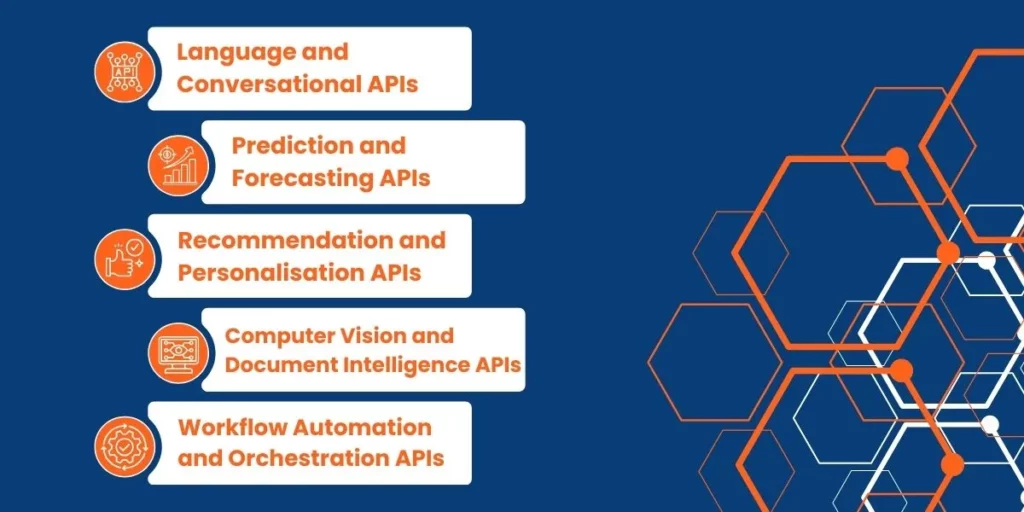
The most impactful artificial intelligence APIs for business usually fall into a few clear categories: language, prediction, vision, recommendations, and workflows.
- Language and Conversational APIs
These tools are the backbone of chatbots, virtual secretaries, and intelligent support desks. You will be able to manage frequently asked questions, categorise customer support tickets, and even write emails or proposals. Consequently, your staff will take care of tougher cases while ordinary queries are handled in no time at all. - Prediction and Forecasting APIs
Prediction APIs spotlight trends in sales, inventories, customer churn, or risks. They point out who is likely not to purchase again, what goods are going to sell well, and where the income might be low. - Recommendation and Personalisation APIs
These APIs assist you in recommending the appropriate product, article, or offer just when it is most needed. They are constantly analysing the users’ actions and inclinations. - Computer Vision and Document Intelligence APIs
Vision APIs are capable of interpreting images, videos, and written documents. They can perform data extraction from invoices, identification cards, or forms, and at the same time, they can discover defects or problems in pictures and videos. - Workflow Automation and Orchestration APIs
They help you move from insight to outcome automatically. Used well, they form the backbone of digital transformation with AI APIs, ensuring AI is not just analysing data but actually changing how work flows across the organisation.
How Can Artificial Intelligence APIs Modernise Legacy Systems Faster?
Legacy systems are the ones that would still house the crucial data but would get the worst day-to-day rankings due to being slow, hard to maintain and change. An ai api for enterprise software can be used to wrap intelligence around what works instead of fully replacing them. With this, you will be able to simplify the core systems with better search, recommendations, and automation.
The reason for this is that if AI logic lives in APIs, the user will always keep the legacy systems stable, but the user can extend the capabilities at the edges. For instance, you may add a smart assistant to the old CRM or predictive maintenance to the ageing ERP. Consequently, the users will get a modern experience even though the underlying platforms remain unaltered.
This tactic also serves you long-term. You can gradually phase out legacy components while still making progress with AI initiatives. While you are modernising system by system, AI APIs will still act as a common intelligence layer that caters to both old and new systems, thereby assuring continuity and minimising the risk.
What Does a Successful AI API Integration Strategy Look Like for Enterprises?
A solid strategic plan has its foundation in business outcomes rather than technology. You start by identifying 3 to 5 use cases that can be of great value, like, for instance, reducing churn, improving customer service, or managing stock better, and then you architect your system with them as the backbone. Consequently, integrating AI APIs in digital systems is a fast way to realise the outcomes instead of an ivory-tower IT project.
Then you proceed to governance and scalability. You define unambiguous rules concerning data accessibility, API security, monitoring, and model performance. Everyone knows which APIs to get, how to use them, and how to assess the impact.
Lastly, you focus on human and process resources. The product manager, the engineer, and the business stakeholder collaborate in the AI use case area and keep the communication loop very clear. The provision of documentation, templates, and playbooks facilitates rapid adoption of the platform by newcomers.
Looking to Transform Your Business? Here’s How AI APIs Deliver Real Value
If you want to move from buzzwords to real outcomes, you need to connect AI directly to your workflows, data, and teams. That’s how you achieve sustainable digital transformation with AI APIs instead of isolated pilots that fade out after a few months.
- Decisions based on data: Real-time AI APIs are running analysis over patterns in sales, support, and operations. With this, the leaders can see more clearly and with a quicker strategy, support measurable business transformation ai api outcomes.
- Refine your customer experience: Every interaction is made easier by chatbots, smart search, and personalised recommendations. Customers receive faster responses and more suitable choices, while your teams deal with fewer monotonous activities.
- Increase productivity without exhaustion: AI takes care of routine work like tagging, summarising, or data entry. Thus, employees spend their time on the creative side of problem-solving, relationship-building, and innovation, rather than on administrative tasks.
- Eliminate risk while innovating: Using APIs, the AI is hidden behind, and thus, you can try new things in small, supervised pilots. Once you find what works, you replicate it across products and geographies without much restructuring.
- Prepare your tech stack for the future: You add or swap the APIs with the coming of the new AI models, rather than having to go through the process of rewriting the core systems.
Ready For Digital Transformation?
Grow your business with advanced technology and expert digital solutions.
You have a vision. We can help you achieve it.
Bring your vision to life with our expert team. As a global leader, we pave the way in the new era, bringing your ideas to fruition. Partner with us to make your vision a success.
Conclusion
The competitive edge resulting from digital transformation comes from the time it takes to link intelligence with day-to-day work. AI application programming interfaces (APIs) allow you to upgrade the experiences of your customers, refine the efficiency of your operations, and extract the value from the data you already have, without a complete overhaul and starting from scratch.
At Revinfotech, we help organisations to apply ai api integration into practice in a way that’s secure, scalable, and aligned with real business goals. We will work with you to identify high-impact use cases, design strong architectures, and integrate AI into your existing systems step by step. Together, our expertise will help in building solutions that not only deliver quick wins but also set up a long-term foundation for smarter, faster, and more resilient digital operations.
Frequently Asked Questions
How quickly can a typical AI API project show measurable results?
+Do we need to replace our existing systems to start using AI APIs?
+What skills does our team need to work with AI APIs Successfully?
+How do we measure whether an AI API initiative is successful?
+Do you have an exciting mobile app idea in mind?
We can help you build a mobile app on an affordable budget. Contact us!